Packet Radio: What It Is and What It Isn’t covered the machinery: AX.25 frames, modems, TNCs, and how stations share a channel. This post steps back to the question most people actually start with: what can you do with it?
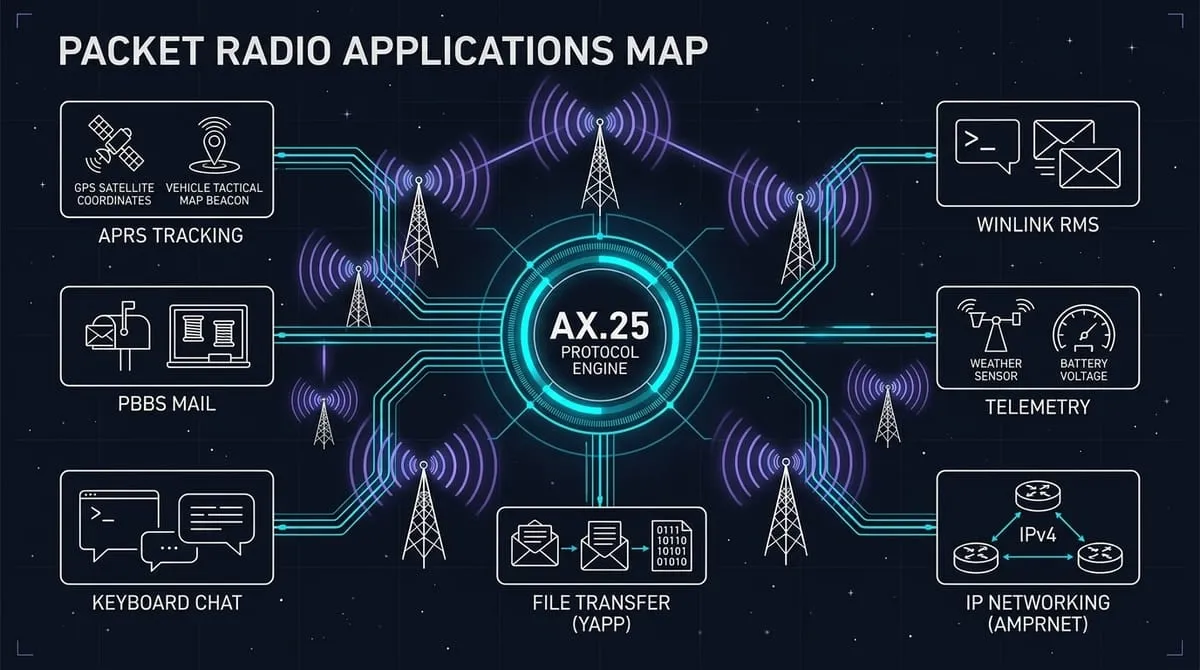
This is the second post in the packet radio series. It’s a map. Each application below gets its own post over the following weeks; here, the point is how they differ, because that difference is mostly one choice: whether an application uses AX.25’s connected sessions or its unconnected UI frames.
01 · Two Ways to Use AX.25
As the first post described, AX.25 offers two kinds of service:
- Connected sessions: two stations set up a link, and every frame is numbered, acknowledged and resent if lost. Dependable, but strictly between two stations.
- UI frames: sent once, to everyone in range, with no acknowledgement. Unreliable on their own, but they reach every listener at once.
Every packet application picks one of these, and that choice explains most of its behaviour:
| Application | AX.25 service | What it does | In depth |
|---|---|---|---|
| APRS | UI frames | Live positions, objects, weather and short messages, shared with everyone in range | Oct 29 |
| BBS mail | Connected | Stores messages and forwards them system to system | Nov 5 |
| Keyboard chat | Connected | Live conversation, two stations or many through a chat server | Nov 12 |
| Winlink | Connected | Radio email through gateways, or station to station | Nov 19 |
| File transfer | Connected | Moves files without wasting airtime on extra acknowledgements | Nov 26 |
| Telemetry | UI frames | Sensor readings in the APRS telemetry format | Dec 3 |
| IP | Either | Internet protocols carried in AX.25 frames | Dec 10 |
02 · The Broadcast Applications
APRS sends every report as a UI frame. It’s built around the idea that everyone in range should see the same live picture: who’s where, what the weather is, where the net control station is [1][2]. A missed packet doesn’t matter much, because the next report replaces it. Even APRS messages, which do get acknowledgements, get them from the APRS software, not from an AX.25 connection [2].
Telemetry is APRS’s format for sensor readings: five analog values and eight on-off channels per report, with separate messages that give them names, units and scaling [2]. A battery voltage on a remote site is a typical example.
What the broadcast applications have in common is that they share one channel with everyone around them. Their limits are about airtime: how often each station transmits, and how far its packets are relayed.
03 · The Connected Applications
BBS mail stores a message and forwards it from system to system over separate connected sessions, until it reaches the recipient’s home BBS. The FBB forwarding protocol has one BBS propose a batch of messages and the other accept, refuse or defer each [3].
Keyboard chat is the simplest packet application: connect to another station and type. Chat servers such as BPQChat extend it to rooms, called topics, shared by many users and linked across nodes [4].
Winlink carries email. A client connects to a nearby gateway and exchanges messages with the Winlink system, using B2F, an open extension of the FBB protocol [5].
File transfer over packet uses protocols such as YAPP, designed so that the sender streams data and leaves delivery to AX.25 instead of waiting for an acknowledgement after every block [6].
These applications move one message, file or conversation between two endpoints, and they need it to arrive intact. Their limits are about turnarounds: every acknowledgement is a moment when the radio has to stop and switch direction.
04 · IP Rides on Top
TCP/IP can run over AX.25 too. An IP packet travels in an AX.25 frame marked with protocol identifier 0xCC [7]. That opens up old, plaintext internet services such as Telnet and Gopher. It also runs into packet’s speed and into Part 97’s ban on messages encoded to obscure their meaning, which rules out encrypted protocols like HTTPS and SSH [8].
05 · The Networks Underneath
Applications need a way to reach beyond one station’s range. Packet has three:
- Digipeaters relay a frame on the same frequency. They’re simple, and the basis of APRS, but every hop sends the frame again on the shared channel. AX.25 v2.2 limits digipeating to two hops [7].
- Nodes (NET/ROM, BPQ and similar software) carry a connection onward from node to node, often on other frequencies or bands. Users often reach BBSes, chat servers and Winlink gateways through them.
- TARPN, the Terrestrial Amateur Radio Packet Network, takes nodes further. Its nodes are G8BPQ software on Raspberry Pi computers with external TNCs, and every link is a dedicated point-to-point link: one radio per neighbouring node, used for nothing else [9]. With no competing stations on a link, the TNC’s timers can be set for maximum performance, and each link runs independently, so a node can receive on one link while transmitting on another [9][10]. TARPN’s stated reason is to “overcome congestion and collision problems” of shared channels [10].
06 · What Packet Isn’t For
The same limits run through every application. Packet is slow, so it suits text, positions, readings and small files, not audio, video, modern web pages or large downloads. It’s shared, so a station’s habits affect everyone on the channel. And it’s open: anyone can read it, and Part 97 forbids encoding messages to hide their meaning [8].
07 · The Series
| Date | Post |
|---|---|
| Oct 15 | Packet Radio: What It Is and What It Isn’t |
| Oct 22 | What Packet Radio Is Used For (this post) |
| Oct 29 | APRS |
| Nov 5 | BBS and store-and-forward mail |
| Nov 12 | Keyboard chat, Convers and node chat |
| Nov 19 | Winlink over packet |
| Nov 26 | File transfer |
| Dec 3 | Telemetry |
| Dec 10 | IP and plaintext services |
08 · Primary References and Citations
- APRS, APRS: Automatic Packet Reporting System, aprs.org.
- APRS Working Group, APRS Protocol Reference, Protocol Version 1.0, document v1.0.1, aprs.org. UI frames, messages and acknowledgements, and telemetry (Chapter 13).
- Jean-Paul Roubelat, F6FBB, FBB Forwarding Protocol, f6fbb.org.
- John Wiseman, G8BPQ, The G8BPQ Chat Server, cantab.net.
- Winlink Development Team, Open B2F: Winlink Message Structure and B2 Forwarding Protocol, winlink.org/B2F.
- Jeff Jacobsen, WA7MBL, YAPP(tm) protocol for Packet Radio binary file transfer, ir3ip.net.
- TAPR, AX.25 Link Access Protocol for Amateur Packet Radio, Version 2.2, July 1998, ax25.net. PID definitions and the two-hop digipeating limit.
- 47 CFR § 97.113, Prohibited transmissions, eCFR.
- TARPN, TARPN Features, tarpn.net. G8BPQ nodes on Raspberry Pi, dedicated point-to-point links, and TNC timers on uncontested links.
- TARPN, Node/Switch Diagram and brief description, tarpn.net. One link per neighbour, run independently, to overcome congestion and collisions.
Key Takeaways
One Choice Shapes Every Application
APRS and telemetry broadcast UI frames to everyone; BBS mail, chat, Winlink and file transfer use connected sessions between two stations. Broadcast applications are limited by shared airtime, connected ones by turnarounds.
Networks Come in Three Kinds
Digipeaters relay on the same frequency, nodes carry connections onward across frequencies, and TARPN builds its network from dedicated point-to-point links to avoid shared-channel collisions.
The Limits Are Shared
Every packet application is slow, shares the channel, and is readable by anyone. That’s why packet suits text, positions and readings, not media or encrypted traffic.